
What Is a Heat Pump? Your Guide to a Different Way to Stay Cool
If you live in Greater Boston, you probably know the routine. Summer hits, the window AC rattles all night. Then winter shows up, the boiler or furnace takes over, and you brace for the next utility bill.
That's why so many homeowners are asking, “What is a heat pump?” and whether it makes sense in an older Boston house. The short answer is simple: it's one system that can cool your home in summer and heat it in winter. The more useful answer is that a heat pump changes how your house gets comfortable, and that can affect installation choices, operating costs, and how well the system works in our climate.
A lot of the confusion comes from the name. People hear “pump” and think plumbing. In HVAC, a heat pump is really a machine that moves heat from one place to another. Once that clicks, the rest gets much easier to understand.
An All-In-One Solution for Boston Weather
Boston homes ask a lot from comfort equipment. We get sticky summer days, shoulder-season temperature swings, and long heating seasons. In plenty of houses, especially triple-deckers and older colonials, the setup is patched together over time: window units upstairs, maybe central AC downstairs, then a boiler, furnace, or electric heat doing winter duty.
A heat pump offers a different approach. Instead of using one system for cooling and another for heating, it handles both jobs. For a homeowner, that means fewer moving parts in the big-picture sense. You're not juggling separate equipment strategies for July and January.
Why this feels different from older systems
Traditional heating equipment usually creates heat. A furnace burns fuel. An electric baseboard turns electricity directly into heat. A heat pump works differently. It relocates heat, and that difference is why people pay attention to them when energy use is part of the conversation.
For Boston-area homeowners, the appeal usually comes down to a few practical points:
Year-round comfort: One system can cool in summer and heat in winter.
Cleaner room-by-room control: Ductless setups can help in homes with hot upper floors or uneven temperatures.
Less dependence on old equipment: Some homeowners use a heat pump to reduce how much they rely on an aging boiler or furnace.
Good fit for older housing stock: Many homes here don't have ductwork, which makes ductless options attractive.
Why Boston homeowners keep asking about them
The question usually isn't only “what is a heat pump?” It's also, “Will this work in my house?” That's the right question.
A renovated condo in South Boston, a triple-decker in Dorchester, and a drafty older home in Quincy can all need very different solutions. Some homes are good candidates for a straightforward installation. Others need electrical work, duct updates, or weatherization to get the results the homeowner expects.
That's why heat pumps are worth understanding before you shop. The equipment matters, but the home matters just as much.

How a Heat Pump Heats and Cools Your Home
The easiest way to understand a heat pump is to think about your refrigerator. A fridge doesn't “make cold.” It pulls heat from inside the box and dumps that heat somewhere else. A heat pump uses the same basic idea, just for your house.
According to the U.S. Department of Energy's guide to heat pump systems, heat pumps transfer heat rather than generate it. During heating season, they pull heat from outdoor air or the ground and move it indoors. During cooling season, they reverse the process and move indoor heat outside.
The three parts most homeowners should know
You don't need to memorize the whole refrigeration cycle, but it helps to know the basic pieces:
Outdoor unit: This is the part outside that exchanges heat with outdoor air.
Indoor unit: This delivers warmed or cooled air into the home.
Refrigerant: This is the fluid that carries heat through the system.
The system uses electricity to run compressors, fans, and controls. But the key point is that the electricity is mainly helping the machine move heat, not create it the way electric resistance heat does.
What it's doing in winter and summer
In winter, the heat pump collects available heat from outside air and brings it indoors. That sounds strange at first because outdoor air feels cold to us. But there's still heat energy there, and the system is designed to capture and upgrade it.
In summer, the cycle flips. The heat pump removes heat from indoor air and sends it outside, just like an air conditioner.
A simple way to picture it:
Season | What the heat pump does | What you feel inside |
Winter | Pulls heat from outside and moves it in | Warm air |
Summer | Pulls heat from inside and moves it out | Cool air |
Why that matters for your utility bills
Because a heat pump moves heat instead of generating it from scratch, it can be very efficient. The DOE heat pump guide notes that well-installed systems achieve seasonal COP between 2.0 and 2.5, meaning they deliver 2 to 2.5 units of heating or cooling energy for every unit of electrical energy consumed, and a 2022 MassCEC and NYSERDA study measured a seasonal COP of 2.3 across 43 homes in the Northeast in real installations, all summarized in the DOE resource on heat pump systems.
That doesn't mean every home gets identical results. Installation quality, insulation, duct design, and controls all matter. But the basic reason heat pumps draw interest is straightforward: they can do more with the electricity they use than older electric heating methods.
Types of Heat Pumps for Your Boston Home
Most Boston homeowners are really choosing between a few practical categories, not dozens of wildly different systems. The big split is usually air-source versus ground-source, and then within air-source, ducted versus ductless.
Air-source heat pumps
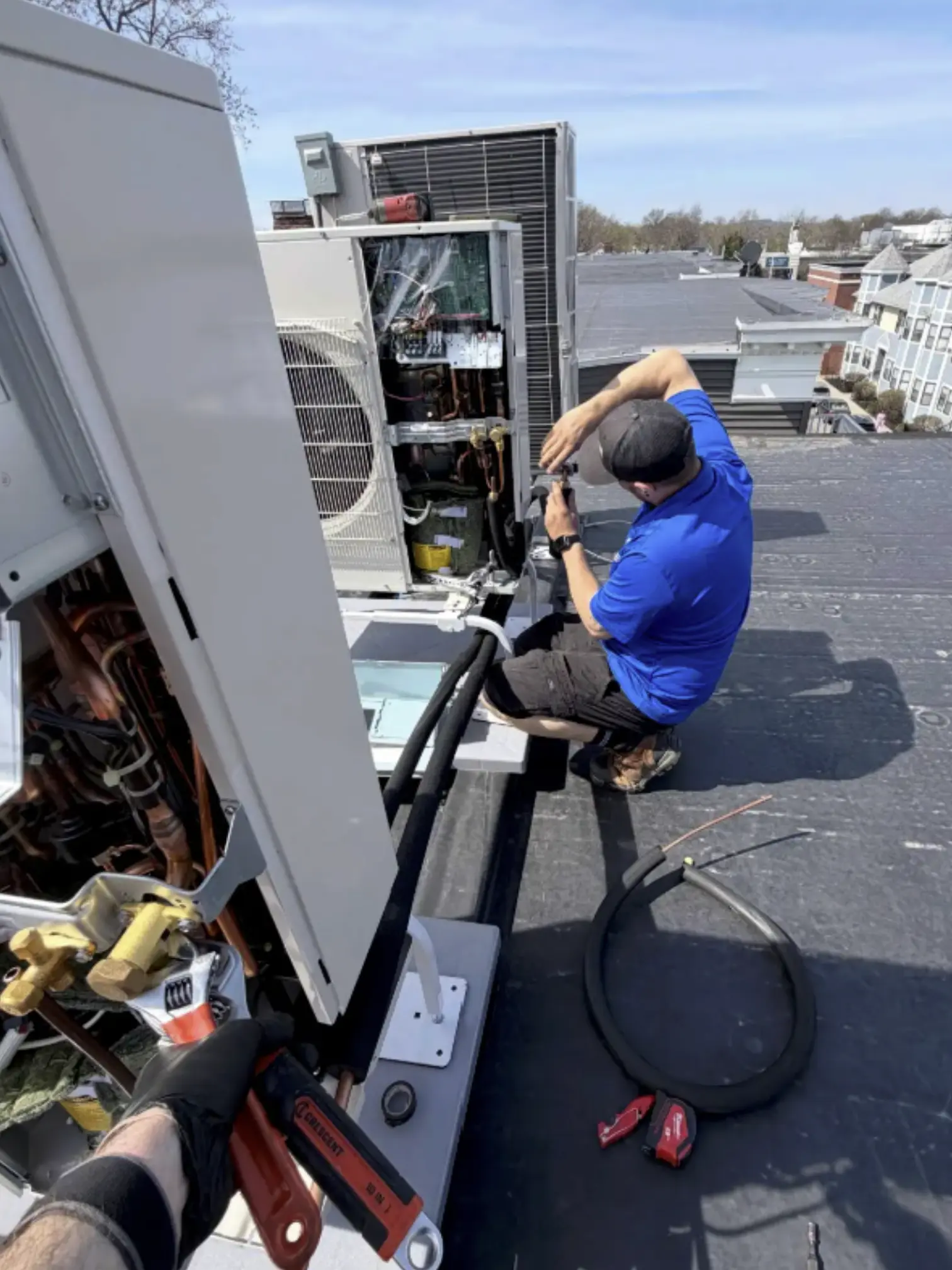
This is the type most homeowners see first. An air-source heat pump exchanges heat with outdoor air.
For Boston homes, this category usually comes in two forms:
Ducted systems: These use ductwork, similar to central air. They can work well if the home already has good ducts or if a renovation makes new ducts practical.
Ductless mini-splits: These use wall-mounted, floor-mounted, or concealed indoor units instead of full-house ductwork.
Ductless systems are often a strong fit for older local housing. If you've got a triple-decker, an upstairs addition, or a house with no existing ductwork, mini-splits can solve comfort problems without opening every wall and ceiling. If you want a closer look at where these systems fit, this ductless heat pump guide for Boston property owners is a useful next read.
Ground-source systems
Ground-source, often called geothermal, works on the same basic principle but uses the ground instead of outdoor air as the heat source and heat sink. These systems can be very effective, but the installation is a different animal.
They typically require underground loop work and more site planning. That can make them a tougher fit for tight urban lots or homes where access is limited.
Which one fits which kind of house
A quick practical comparison helps:
Home type | Often a practical option | Why |
Triple-decker with no ducts | Ductless air-source | Easier retrofit, room-by-room zoning |
Single-family with usable ducts | Ducted air-source | Can replace or work with central system |
Major renovation or large lot | Ground-source | More involved project, broader site work |
Historic home with limited wall space | Case-by-case | Layout and preservation concerns matter |
The real-world decision
Homeowners often do not choose based only on efficiency charts. They choose based on what's behind the walls, how many zones they want, whether the electrical service can support the project, and how much disruption they're willing to accept.
That's why the answer to what is a heat pump quickly turns into another question: what kind of heat pump works in this house? For a lot of Greater Boston homes, that's where the actual decision starts.
Can a Heat Pump Handle a Boston Winter
This is the question I hear most, and it usually comes with some version of, “Yeah, but does it work when it's cold?” The answer is yes, with an important condition. It has to be the right system, and it has to be properly designed and installed.
The old idea that heat pumps are only for mild climates is outdated. The DOE's page on air-source heat pumps explains that modern air-source systems typically deliver 3 to 4 units of heat output per unit of electrical input at moderate outdoor temperatures.
What changes when the temperature drops
A heat pump can still heat in cold weather, but its performance declines as outdoor temperature falls. That doesn't mean it stops working. It means the system has to work harder, and output changes with conditions.
For homeowners, the important point is this: many winter days in Greater Boston are cold, but not deep-freeze cold. That's a range where modern systems can be very useful, especially when matched correctly to the building.
The balance point in plain English
The balance point is the outdoor temperature at which the heat pump alone may no longer cover the full heating load of the house. The installation guidance in the data notes that control strategies commonly manage the shift between heat-pump-only operation and supplemental heat around 30 to 35°F.
That doesn't mean every home flips over at the same number. A tighter, better-insulated home and a leaky older house won't behave the same way.
Here's the practical version:
On milder winter days: The heat pump can often carry the load comfortably.
On colder days: It may still run well, but output drops.
On the coldest stretches: Supplemental heat may be needed, depending on system design.
Why installation matters so much
The success or disappointment of many projects often hinges on this specific factor. The DOE air-source heat pump guidance says airflow should be about 375 to 450 cubic feet per minute per ton of capacity, and if it drops below roughly 350 cfm/ton, both capacity and efficiency fall, and coil icing risk goes up, according to the DOE's air-source heat pump page.
That sounds technical, but the takeaway is simple. A heat pump is not plug-and-play. Ducts, fan settings, controls, refrigerant charge, and sizing all affect whether the homeowner says, “This thing is great,” or “Why is this room still cold?”
A realistic Boston answer
Yes, a heat pump can absolutely be part of a serious heating strategy here. In some homes, it serves as the main heating source. In others, it works alongside supplemental heat or an existing system.
What matters is realism. If you want dependable comfort in January, the job has to account for the house itself, not just the equipment label.
Key Benefits and Potential Drawbacks
Heat pumps are getting a lot more attention, and not just from contractors. Market data gathered at Heat pump market statistics and shipment trends shows U.S. air-source heat pump shipments rose from 1.44 million units in 2001 to 4.33 million in 2022, a 200% increase, and reached 4.12 million units in 2024, while the same source projects 10.6% CAGR from 2026 to 2033 for the U.S. market and says the global market is projected to grow from USD 94.53 billion in 2025 to USD 200.65 billion by 2033.
That doesn't mean a heat pump is right for every house. It does mean more homeowners are taking a serious look, and more equipment options are available than there used to be.
Where heat pumps shine
A good heat pump setup can offer some real advantages in Boston homes:
One system for two seasons: Heating and cooling come from the same basic equipment.
Strong efficiency potential: Especially compared with older electric heat.
Room-by-room comfort options: Ductless systems can help with uneven temperatures.
Better fit for AC upgrades: If you already need cooling, a heat pump can change the conversation from “add AC” to “upgrade the whole comfort system.”
For landlords and owner-occupants in multifamily properties, that flexibility can matter. A top-floor unit that overheats in summer and feels chilly in shoulder seasons may benefit from zoning and targeted conditioning.
Where homeowners get surprised
The drawbacks are usually not deal-breakers, but they're real:
Higher upfront complexity: The project may involve more than swapping one box for another.
Performance depends on the house: Drafty rooms, weak insulation, and bad ducts can limit results.
Cold-weather planning matters: Some homes need a supplemental heat strategy.
Older homes may need electrical work: Panel capacity can become part of the project.
The honest tradeoff
If you want the shortest, simplest equipment replacement, a heat pump may not always be that. If you want a more modern, flexible way to heat and cool, it can be a strong option.
That is the fundamental pros-and-cons discussion. Heat pumps often reward homeowners who are willing to think about the whole house, not just the outdoor unit.
Understanding Costs and Mass Save Rebates
Most homeowners don't start with efficiency ratings. They start with, “What's this going to cost me?” Fair question.
The tricky part is that heat pump pricing isn't one-size-fits-all. A single-zone ductless install in a condo is a very different project from a whole-home ducted system in a larger house. Add an electrical upgrade, duct repairs, or insulation work, and the project scope changes again.
For 2026, Mass Save lists air-source heat pump rebates by tonnage and project type: Whole-Home, Partial-Home, and Basic. Eligibility depends on equipment, installation type, heating displacement, utility account, and program rules, so homeowners should confirm details directly with Mass Save before budgeting.
Why the price can vary so much
One of the most overlooked facts about heat pumps is that they're often not just appliance swaps. The Carrier-based background explains that good performance depends on things like insulation, duct condition, electrical capacity, and overall project scope, and that many installations are not one-for-one replacements because airflow, load calculation, and sometimes panel or duct improvements all matter, as discussed in Carrier's overview of what a heat pump is and how it works.
That lines up with what we see in older Boston housing. A homeowner may think they're shopping for one piece of equipment when they're really planning a broader system upgrade.
What to check before you think about rebates
Before you focus on incentives, look at these basics:
Electrical service: Older panels may need review before new equipment goes in.
Duct condition: Existing ducts might help, or they might hold the system back.
Insulation and air sealing: These affect comfort as much as the equipment does.
Project goals: Whole-home replacement is different from adding comfort to one problem area.
If you're researching local incentives, Boston-area homeowners can review the company's Mass Save program page as a starting point, then confirm current program details directly through the official rebate sources tied to their address and utility account.
The smart way to budget
Ask contractors to separate the proposal into parts. Equipment, electrical work, duct modifications, controls, and any weatherization-related items should be easy to identify. That makes it easier to compare bids and understand where the money is going.
It also keeps expectations realistic. A heat pump project can be a straightforward install, or it can be part of a larger home-upgrade decision.
Hiring a Pro and Maintaining Your System
A lot of Boston homeowners get stuck here. The equipment sounds good on paper, the rebate looks attractive, and then the install goes into a 100-year-old triple-decker with uneven rooms, patched-together ductwork, or wiring that has been added to piece by piece over decades. A heat pump can only perform as well as the house and the installer allows.
That is why the contractor matters so much. Good equipment in a poorly planned setup is like putting a new engine in a car with bad tires and misaligned steering. You still will not get the ride you expected.
A proper installer should size the system with a real heating and cooling load calculation, such as ACCA Manual J, instead of guessing from square footage or copying the size of the old furnace or AC. They should also check airflow through the duct system. For ducted systems, proper airflow is critical. Low airflow can reduce capacity and efficiency and can contribute to coil-freezing or comfort problems. In an older Boston house, that kind of setup problem can show up as cold back bedrooms, noisy ducts, or a system that runs hard without making the house feel right.
What to ask an installer
Listen for how the contractor plans the job.
How are you sizing the system? Ask if they are using a room-by-room load calculation.
What are you checking in the existing ducts, if there are ducts? Older returns, undersized supplies, and leaky runs can hold back a good heat pump.
How will this house handle cold weather? In Boston, that answer should be specific to your insulation, air leakage, and backup heat plan.
What happens at startup? Airflow, refrigerant charge, and control settings should be tested and adjusted, not left at factory defaults.
What is included beyond the equipment? Electrical work, line-set covers, condensate routing, patching, and thermostat or control upgrades should be clear in writing.
Older homes require extra care in these situations. A historic house with radiators may be a strong fit for ductless heads in a few key areas. A triple-decker with existing ducts may need duct repairs before a central system can deliver even comfort. The right answer is rarely the same from one Boston home to the next.
What you can do as a homeowner
You do not need to touch refrigerant or open up the equipment. You can still do a lot to help the system last and run well.
Keep filters clean. Keep outdoor units clear of snow, leaves, and drifting debris. Make sure furniture, curtains, and storage are not blocking indoor heads or supply grilles. Pay attention to small changes, too. New noises, weaker airflow, ice where it should not be, or rooms drifting off temperature are all good reasons to schedule service before a small issue turns into a bigger one.
If you want a simple seasonal checklist, this homeowner's guide to heat pump maintenance walks through the basics in plain language.
If you're comparing options for a heat pump project in Greater Boston, Boston Budget handles residential heating and cooling work, including mini-splits, central heat pumps, maintenance, and Mass Save guidance. Homeowners should still compare proposals, ask detailed installation questions, and confirm what is included for their address, layout, and existing system conditions.
If you're wondering whether a heat pump makes sense for your Boston-area home, the next step is a real evaluation of the house, not a guess based on online averages. Boston Budget can help homeowners in Greater Boston review system options, talk through retrofit concerns in older homes, and understand what may be involved before installation begins.
Boston Budget is a locally owned plumbing, heating, and cooling company proudly serving homeowners in Boston, Quincy, Dorchester, Weymouth, and the surrounding communities. We specialize in boiler maintenance, heating repairs, and energy-efficient HVAC upgrade designed to keep your home safe, comfortable, and affordable, especially during harsh New England winters. With reliable service, transparent pricing, and fast response times, Boston Budget is your trusted local choice for plumbing and heating solutions.


